U.S. Large Cent Coins

(1793 - 1857)

U.S. One-Cent coinage has been a cornerstone of American commerce since the nation’s earliest years, first issued in 1793. The cent has undergone numerous design, size, and composition changes, reflecting evolving economic conditions, metal availability, and artistic trends. From early large copper cents to today’s small Lincoln cents, the one-cent piece tells a continuous story of American history, making it one of the most collected and studied denominations in U.S. numismatics.

Check out every series of U.S. Large Cent Coins below, complete with dates & mintages for each.

Flowing Hair Large Cent

(1793 - 1796)

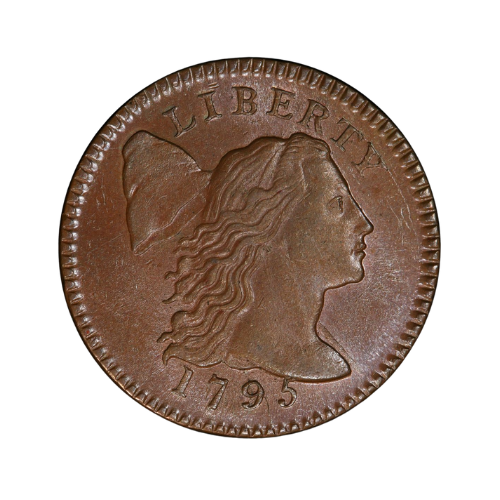
The Flowing Hair Large Cent was the first official one-cent coin struck by the United States Mint, produced in 1793 only. This inaugural design features Liberty with long, unbound hair on the obverse and a simple wreath surrounding the denomination on the reverse. Several distinct varieties were created during its short production run, including the Chain Reverse and the Wreath Reverse, each highly collectible today. Because it represents the very beginning of federal cent coinage, the 1793 Flowing Hair Large Cent is both historically significant and strongly sought after in all grades.

1793 Liberty Cap 1C Large Cent both sides of a coin showing one cent and liberty with long flowing hair
  • Business Strikes

    Type 1, Chain Cent

    1793 Chain | 36,103

    Type 2, Wreath Cent

    1793 Wreath | 63,353

    Type 3, Liberty Cap, Beaded Border

    1793 | 11,056

    Type 4, Liberty Cap, Denticle Border

    1794 | 918,521

    1795 Lettered Edge | 37,000

    1795 Reeded Edge | NA

    1796 | 109,825

Draped Bust Large Cent

(1796 - 1807)

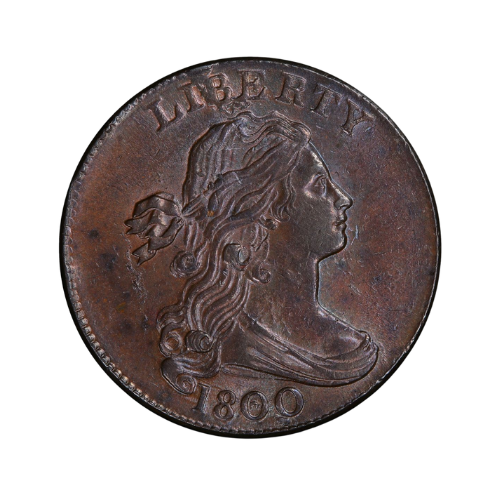
The Draped Bust Large Cent replaced the earlier Flowing Hair design in 1796 and remained in production through 1807. This type features a more elegant portrait of Liberty with flowing hair and drapery at the neckline, paired with either the Small Date/Small Letters style of the late 1790s or the later Heraldic Eagle reverse introduced in 1798. Mintages throughout the series were generally modest, and many dates are difficult to locate in high grades due to heavy circulation and the soft copper planchets of the era. Collectors often note 1799 as one of the key dates in the series, making the Draped Bust Large Cent an important and challenging early U.S. type.

1800 Draped Bust 1C Large Cent both sides of a coin from 1800 showing one cent and liberty
  • Business Strikes

    1796 | 363,375

    1797 | 897,510

    1798 | 1,841,745

    1799 | NA

    1800 | 2,822,175

    1801 | 1,362,837

    1802 | 3,435,100

    1803 | 3,131,691

    1804 | 96,500

    1805 | 941,116

    1806 | 348,000

    1807 | 829,221

Classic Head Large Cent

(1808 - 1814)

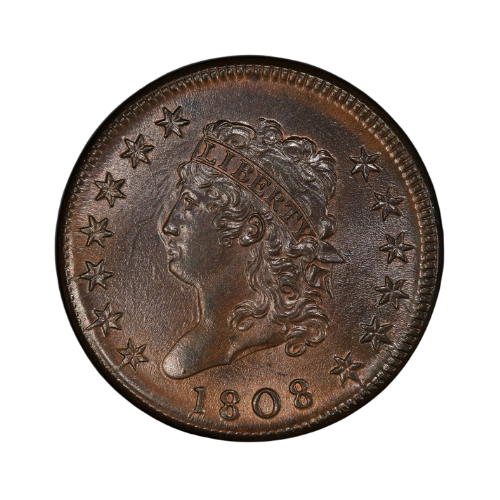
The Classic Head Large Cent was introduced in 1808, ushering in a refreshed portrait of Liberty designed by John Reich. This design presents Liberty with a more stylized, youthful appearance and a headband inscribed with “LIBERTY,” marking a clear departure from the earlier Draped Bust style. The series was produced from 1808 through 1814, though mintages were relatively low in several years. Many surviving examples show heavy wear or surface issues due to the quality of copper used at the time, making high-grade pieces especially desirable. Key dates such as 1809 and 1811 are particularly sought after by collectors assembling early large cent sets.

1810 Classic Head 1C Large Cent both sides of a coin showing one cent and United States of America
  • Business Strikes

    1808 | 1,007,000

    1809 | 222,867

    1810 | 1,458,500

    1811 | 218,025

    1812 | 1,075,500

    1813 | 418,000

    1814 | 357,830

Coronet Head Large Cent

(1816 - 1839)

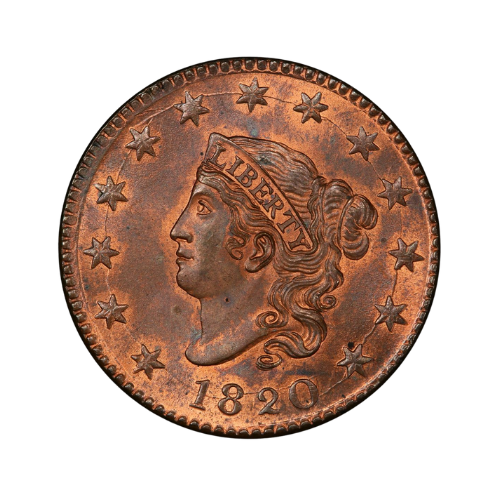
The Coronet Head Large Cent debuted in 1816, marking the return of cent production after a brief suspension during the War of 1812 era. Designed by Robert Scot and later modified by other engravers, this type features Liberty wearing a coronet inscribed with “LIBERTY,” giving the series its commonly used name. The design remained in use through 1857, making it one of the longest-running large cent types. Over time, subtle design adjustments created collectible subtypes, including the Matron Head (1816–1839) and the later Braided Hair style (1839–1857). Certain dates, such as 1823, 1827, and 1857, are particularly desirable, and the 1857 issue represents the final year of large cent production before the smaller Flying Eagle cent was introduced.

1820 Coronet Head 1C Large Cent both sides of a rare coin showing lady liberty and one cent
  • Business Strikes

    1816 | 2,820,982

    1817 | 3,948,400

    1818 | 3,167,000

    1819 | 2,671,000

    1820 | 4,407,550

    1821 | 389,000

    1822 | 2,072,339

    1823 | NA

    1824 | 1,262,000

    1825 | 1,461,100

    1826 | 1,517,425

    1827 | 2,357,732

    1828 | 2,260,624

    1829 | 1,414,500

    1830 | 1,711,500

    1831 | 3,359,260

    1832 | 2,362,000

    1833 | 2,739,000

    1834 | 1,855,100

    1835 | 3,878,400

    1836 | 2,111,000

    1837 | 5,558,300

    1838 | 6,370,200

    1839 | 3,128,661

Braided Hair Large Cent

(1839 - 1857)

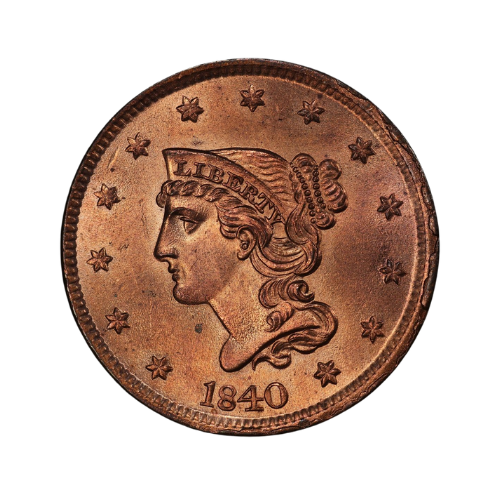
The Braided Hair Large Cent was introduced in 1839 as a refinement of the earlier Coronet design and represents the final major style of the large cent series. Liberty is depicted with her hair intricately braided and tied in a bun, reflecting the more polished engraving standards of the mid-19th century. This subtype was struck from 1839 through 1857 and includes both early transitional issues and later dates with higher mintages as copper coin production increased. While many examples are obtainable in circulated grades, certain varieties and high-grade pieces remain challenging. The 1857 issue marks the end of large cent coinage, as the denomination was replaced later that year by the smaller Flying Eagle cent.

1840 Braided Hair 1C Large Cent both sides of a rare coin showing one cent within a wreath
  • Business Strikes

    1839 | 200,000

    1840 | 2,462,700

    1841 | 1,597,367

    1842 | 2,383,390

    1843 | 2,425,342

    1844 | 2,398,752

    1845 | 3,894,804

    1846 | 4,120,800

    1847 | 6,183,669

    1848 | 6,415,799

    1849 | 4,178,500

    1850 | 4,426,844

    1851 | 9,889,707

    1852 | 5,063,094

    1853 | 6,641,131

    1854 | 4,236,156

    1855 | 1,574,829

    1856 | 2,690,463

    1857 | 333,456

If You Collect Large Cent Coins, Check Out The ‘Pre '99 Major Circulation Designs’ Type Set!

a coin collection checklist with examples from major designs before 1999

‘Coin Collecting Tools’ is Going Mobile

StackHub App Monthly Membership StackHub App Monthly Membership
Quick View
StackHub App Monthly Membership
$4.99 every month

StackHub is an excellent tool for coin collectors & precious metals enthusiasts of all levels. Your app subscription will come complete with:

  • 100+ prebuilt collection checklists to choose from

  • Collect graded or ungraded coins, your choice

  • Upload images of your own set to take on the go

  • Precious Metals stack tracking

  • Every coin collecting guide at your fingertips

  • Compatible with mobile & desktop

Click HERE to learn more

*During checkout, please use the email address that you’d like associated with your StackHub account. You will receive an invitation to that email address directly from the platform when your account is ready. Account creation may take up to 12 hours from the time of checkout*

multiple stacks of banded $100 one hundred dollar bills from the bank

How to Find Valuable Banknotes - A Beginner’s Guide to Bank-Strap Hunting

Click here for the full guide
a coin roll from the bank with ten cent dimes, the face of a Roosevelt dime on the end

Coin Roll Hunting: What It Is and How to Start

Coin roll hunting is the modern-day treasure hunt for collectors. Learn what it is, how to start, and the best tips for finding silver and rare coins in rolls.

Read More

This site and all of its content was built by collectors for collectors. Join thousands who already trust CoinCollectingTools.com for reliable & accurate information, expert tips, and a connected community on social media. Follow us on YouTube & TikTok @CentsMakeDollars to make sure you never miss a new online resource designed to sharpen your knowledge and collecting strategies.