U.S. Five-Cent Nickels
(1866 - Current)
U.S. Five-Cent coinage, commonly known as the nickel, was first issued in 1866 following the Civil War. Unlike earlier silver-based five-cent pieces, the nickel introduced a durable copper–nickel alloy that remains in use today. Over time, the denomination has featured some of the most iconic designs in U.S. coinage, reflecting changes in national identity, artistic style, and minting technology. The five-cent piece remains a staple of American commerce and a popular focus for collectors of all levels.
Check out every series of U.S. Five-Cent Nickels below, complete with dates & mintages for each.
Shield Nickel
(1866 - 1883)
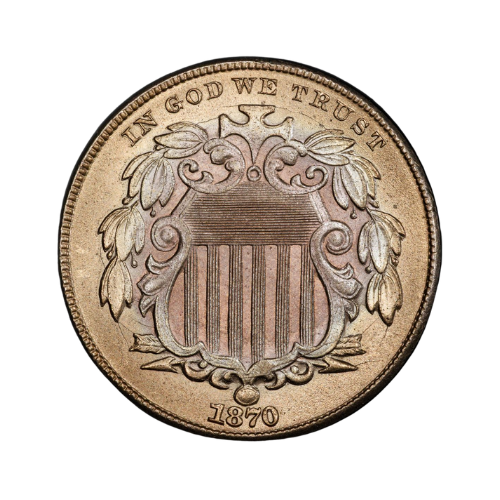
The Shield Nickel was the first five-cent coin struck in copper-nickel, replacing the earlier silver half dime. Produced from 1866 to 1883, it was introduced in the aftermath of the Civil War when silver coins had largely disappeared from circulation and base-metal coinage was needed for everyday commerce.
The obverse features a large Union shield, symbolizing national unity following the war, while the reverse displays a prominent numeral “5” surrounded by stars and rays (in 1866) or simply stars (1867–1883). The rays were removed after the first year due to striking difficulties, creating two distinct reverse types that collectors recognize today.
Shield Nickels are known for weak strikes and die-clash issues, particularly in the early years. Although none are considered extreme rarities in circulated grades, certain dates and varieties command strong premiums in higher condition. The series was ultimately replaced by the Liberty Head (V) Nickel in 1883.
-
Type 1, With Rays
1866 Rays | 14,742,500
1867 Rays | 2,019,000
Type 2, No Rays
1867 No Rays | 28,890,500
1868 | 28,817,000
1869 | 16,395,000
1870 | 4,806,000
1871 | 561,000
1872 | 6,036,000
1873 Close 3 | 436,050
1873 Open 3 | 4,113,950
1874 | 3,538,000
1875 | 2,097,000
1876 | 2,530,000
1879 | 25,900
1880 | 16,000
1881 | 68,800
1882 | 11,472,900
1883 | 1,451,500
-
Type 1, With Rays
1866 Proof Rays | 600
1867 Proof Rays | 25
Type 2, No Rays
1867 Proof No Rays | 600
1868 Proof | 600
1869 Proof | 600
1870 Proof | 1,000
1871 Proof | 960
1872 Proof | 950
1873 Proof Closed 3 | 1,100
1874 Proof | 700
1875 Proof | 700
1876 Proof | 1,150
1877 Proof | 900
1878 Proof | 2,350
1879 Proof | 3,200
1880 Proof | 3,955
1881 Proof | 3,575
1882 Proof | 3,100
1883 Proof | 5,419
Liberty Head ‘V’ Nickel
(1883 - 1913)
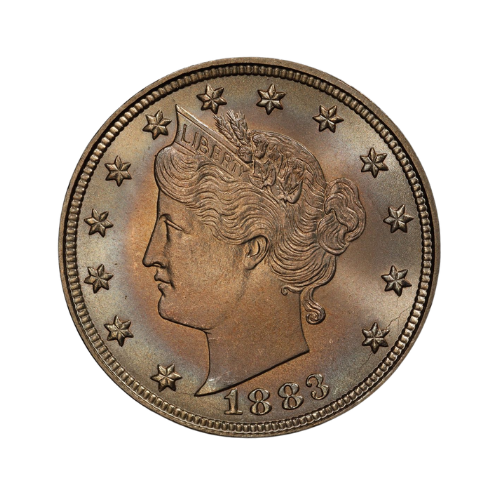
The Liberty Head Nickel—commonly called the “V” Nickel—was produced from 1883 to 1913 and takes its nickname from the large Roman numeral “V” on the reverse. Designed by Charles E. Barber, the obverse features a classical portrait of Liberty wearing a coronet inscribed with “LIBERTY,” while the reverse displays the denomination within a wreath.
The first 1883 issues were struck without the word “CENTS” on the reverse, leading to confusion (and even gold-plating fraud) since the coin’s size resembled a $5 gold piece. Later that same year, “CENTS” was added below the wreath, creating two distinct 1883 types collectors recognize today.
Composed of 75% copper and 25% nickel, the series includes one of the most famous rarities in U.S. coinage: the 1913 Liberty Head Nickel, with only five known examples. The design was officially replaced in 1913 by the Buffalo Nickel, but the mystique of the “V” Nickel continues to make it a popular and widely collected series.
-
Type 1, No ‘CENTS’
1883 No CENTS | 5,474,300
Type 2, With ‘CENTS’
1883 With CENTS | 16,026,200
1884 | 11,270,000
1885 | 1,473,300
1886 | 3,326,000
1887 | 15,260,692
1888 | 10,715,901
1889 | 15,878,025
1890 | 16,256,532
1891 | 16,832,000
1892 | 11,696,897
1893 | 13,368,000
1894 | 5,410,500
1895 | 9,977,822
1896 | 8,841,048
1897 | 20,426,797
1898 | 12,530,292
1899 | 26,027,000
1901 | 26,478,228
1902 | 31,487,581
1903 | 28,004,930
1904 | 21,403,167
1905 | 29,825,124
1906 | 38,612,000
1907 | 39,213,325
1908 | 22,684,557
1909 | 11,585,763
1910 | 30,166,948
1911 | 39,557,639
1912 | 26,234,569
1912-D | 8,474,000
1912-S | 238,000
1913 | 5
-
Type 1, No ‘Cents’
1883 Proof Without CENTS | 5,219
Type 2, With ‘Cents’
1883 Proof With CENTS | 6,783
1884 Proof | 3,942
1885 Proof | 3,790
1886 Proof | 4,290
1887 Proof | 2,960
1888 Proof | 4,582
1889 Proof | 3,336
1890 Proof | 2,740
1891 Proof | 2,350
1892 Proof | 2,745
1893 Proof | 2,195
1894 Proof | 2,632
1895 Proof | 2,062
1896 Proof | 1,862
1897 Proof | 1,938
1898 Proof | 1,795
1899 Proof | 2,031
1900 Proof | 2,262
1901 Proof | 1,985
1902 Proof | 2,018
1903 Proof | 1,790
1904 Proof | 1,817
1905 Proof | 2,152
1906 Proof | 1,725
1907 Proof | 1,475
1908 Proof | 1,620
1909 Proof | 4,763
1910 Proof | 2,405
1911 Proof | 1,733
1912 Proof | 2,145
Buffalo Nickel
(1913 - 1938)
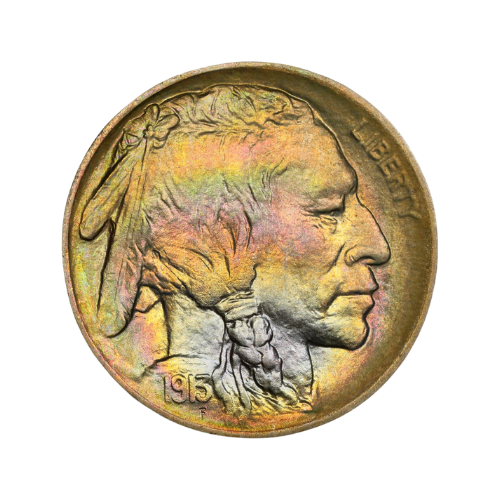
The Buffalo Nickel—also known as the Indian Head Nickel—was introduced in 1913, replacing the Liberty Head design. Created by James Earle Fraser, the obverse features a composite portrait of a Native American chief, while the reverse depicts an American bison, often said to have been inspired by “Black Diamond,” a bison housed at the Bronx Zoo.
The series was struck from 1913 through 1938 in the standard 75% copper and 25% nickel alloy. Two reverse subtypes were produced in 1913: the original “Type 1” with the bison standing on a raised mound, and the modified “Type 2” with a recessed denomination to reduce wear.
Buffalo Nickels are well known for weak strikes and rapid date wear, making fully detailed examples more desirable. Key dates such as the 1913-S Type 2, 1918/7-D overdate, and 1937-D “Three-Legged” variety are especially popular among collectors. The design was replaced in 1938 by the Jefferson Nickel, but it remains one of the most iconic coins in U.S. history.
-
Type 1, "FIVE CENTS" On Raised Ground
1913 Variety 1 | 30,993,520
1913-D Variety 1 | 5,337,000
1913-S Variety 1 | 2,105,000
Type 2, "FIVE CENTS" In Recess
1913 Variety 2 | 29,858,700
1913-D Variety 2 | 4,156,000
1913-S Variety 2 | 1,290,000
1914 | 20,665,738
1914-D | 3,912,000
1914-S | 3,470,000
1915 | 20,987,270
1915-D | 7,569,000
1915-S | 1,505,000
1916 | 63,498,066
1916-D | 13,333,000
1916-S | 11,860,000
1917 | 51,424,019
1917-D | 9,910,000
1917-S | 4,193,000
1918 | 32,086,314
1918-D | 8,362,000
1918-S | 4,882,000
1919 | 60,868,000
1919-D | 8,006,000
1919-S | 7,521,000
1920 | 63,093,000
1920-D | 9,418,000
1920-S | 9,689,000
1921 | 10,663,000
1921-S | 1,557,000
1923 | 35,715,000
1923-S | 6,142,000
1924-D | 5,258,000
1924-S | 1,437,000
1925-D | 4,450,000
1925-S | 6,256,000
1926-D | 5,638,000
1926-S | 970,000
1927-D | 5,730,000
1927-S | 3,430,000
1928-D | 6,436,000
1928-S | 6,936,000
1929 | 36,446,000
1929-D | 8,370,000
1929-S | 7,754,000
1930 | 22,849,000
1930-S | 5,435,000
1931-S | 1,200,000
1934 | 20,213,003
1934-D | 7,480,000
1935 | 58,264,000
1935-D | 12,092,000
1935-S | 10,300,000
1936 | 119,001,420
1936-D | 24,814,000
1936-S | 14,930,000
1937 | 79,485,769
1937-D | 17,826,000
1937-S | 5,635,000
1938-D | 7,020,000
-
Type 1, "FIVE CENTS" On Raised Ground
1913 Proof Variety 1 | 1,520
Type 2, "FIVE CENTS" In Recess
1913 Proof Variety 2 | 1,514
1914 Proof | 1,275
1915 Proof | 1,050
1916 Proof | 600
1936 Proof | 4,420
1937 Proof | 5,769
Jefferson Nickel
(1938 - 2003)
Original Vintage Design (1938–1964)
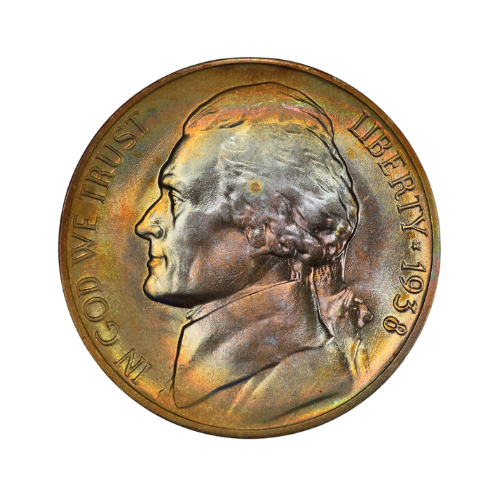
From 1938 through 1942, Jefferson nickels were struck in the standard 75% copper and 25% nickel alloy. During World War II (1942–1945), nickel was needed for the war effort, prompting a temporary composition change. The “War Nickels” were made of 35% silver, 56% copper, and 9% manganese. These coins are easily identified by a large mintmark (P, D, or S) placed above Monticello on the reverse—the only time a “P” mintmark appeared on circulating coinage prior to 1979. Silver was removed from the composition after 1945, returning to the original copper-nickel alloy through 1964.
-
Type 1, Original Vintage Design
1938 | 19,496,000
1938-D | 5,376,000
1938-S | 4,105,000
1939 | 120,615,000
1939-D | 3,514,000
1939-S | 6,630,000
1940 | 176,485,000
1940-D | 43,540,000
1940-S | 39,690,000
1941 | 203,265,000
1941-D | 53,432,000
1941-S | 43,445,000
1942 | 49,789,000
1942-D | 13,938,000
Type 2, Silver Alloy
1942-P Silver | 57,873,000
1942-S Silver | 32,900,000
1943-P Silver | 271,165,000
1943-D Silver | 15,294,000
1943-S Silver | 104,060,000
1944-P Silver | 119,150,000
1944-D Silver | 32,309,000
1944-S Silver | 21,640,000
1945-P Silver | 119,408,100
1945-D Silver | 37,158,000
1945-S Silver | 58,939,000
Type 1, Original Vintage Design
1946 | 161,116,000
1946-D | 45,292,200
1946-S | 13,560,000
1947 | 95,000,000
1947-D | 37,822,000
1947-S | 24,720,000
1948 | 89,348,000
1948-D | 44,734,000
1948-S | 11,300,000
1949 | 60,652,000
1949-D | 36,498,000
1949-S | 9,716,000
1950 | 9,796,000
1950-D | 2,630,030
1951 | 28,552,000
1951-D | 20,460,000
1951-S | 7,776,000
1952 | 63,988,000
1952-D | 30,638,000
1952-S | 20,572,000
1953 | 46,644,000
1953-D | 59,878,600
1953-S | 19,210,900
1954 | 47,684,050
1954-D | 117,183,060
1954-S | 29,384,000
1955 | 7,888,000
1955-D | 74,464,100
1956 | 35,216,000
1956-D | 67,222,940
1957 | 38,408,000
1957-D | 136,828,900
1958 | 17,088,000
1958-D | 168,249,120
1959 | 27,248,000
1959-D | 160,738,240
1960 | 55,416,000
1960-D | 192,582,180
1961 | 73,640,100
1961-D | 229,342,760
1962 | 97,384,000
1962-D | 280,195,720
1963 | 178,851,645
1963-D | 276,829,460
1964 | 1,028,622,762
1964-D | 1,787,297,160
-
Type 1, Original Vintage Design
1938 Proof | 19,365
1939 Proof | 12,535
1940 Proof | 14,158
1941 Proof | 18,720
1942 Proof | 29,600
1950 Proof | 51,386
1951 Proof | 57,500
1952 Proof | 81,980
1953 Proof | 128,800
1954 Proof | 233,300
1955 Proof | 378,200
1956 Proof | 669,384
1957 Proof | 1,247,952
1958 Proof | 875,652
1959 Proof | 1,149,291
1960 Proof | 1,691,602
1961 Proof | 3,028,144
1962 Proof | 3,218,019
1963 Proof | 3,075,645
1964 Proof | 3,950,762
Type 2, Silver Alloy
1942-P Silver Proof | 27,600
Original Modern Design (1965–2003)
Beginning in 1965, the composition remained 75% copper and 25% nickel, but mintmarks were temporarily removed from 1965–1967 to discourage hoarding. The classic obverse portrait and reverse view of Monticello continued unchanged for decades, making this one of the most familiar and widely circulated designs in American coinage.
While most dates are common in circulated grades, key early dates (such as the 1939-D and 1950-D) and high-grade examples remain popular with collectors. The long-running original design concluded in 2003, just before the introduction of the Westward Journey series in 2004.
-
1965 | 136,131,380
1966 | 156,208,283
1967 | 107,325,800
1968-D | 91,227,880
1968-S | 100,396,004
1969-D | 202,807,500
1969-S | 120,075,000
1970-D | 515,485,380
1970-S | 238,832,004
1971 | 106,884,000
1971-D | 316,144,800
1972 | 202,036,000
1972-D | 351,694,600
1973 | 384,396,000
1973-D | 361,405,000
1974 | 601,752,000
1974-D | 277,373,000
1975 | 181,772,000
1975-D | 401,875,300
1976 | 367,124,000
1976-D | 563,964,147
1977 | 585,376,000
1977-D | 297,313,422
1978 | 391,308,000
1978-D | 313,092,780
1979 | 463,188,000
1979-D | 325,867,672
1980-P | 593,004,000
1980-D | 502,323,448
1981-P | 657,504,000
1981-D | 364,801,843
1982-P | 292,355,000
1982-D | 373,726,544
1983-P | 561,615,000
1983-D | 536,726,276
1984-P | 746,769,000
1984-D | 517,675,146
1985-P | 647,114,962
1985-D | 459,747,446
1986-P | 536,883,483
1986-D | 361,819,140
1987-P | 371,499,481
1987-D | 410,590,604
1988-P | 771,360,000
1988-D | 663,771,652
1989-P | 898,812,000
1989-D | 570,842,474
1990-P | 661,636,000
1990-D | 663,938,503
1991-P | 614,104,000
1991-D | 436,496,678
1992-P | 399,552,000
1992-D | 450,565,113
1993-P | 412,076,000
1993-D | 406,084,135
1994-P | 722,160,000
1994-D | 715,762,110
1995-P | 774,156,000
1995-D | 888,112,000
1996-P | 829,332,000
1996-D | 817,736,000
1997-P | 470,972,000
1997-D | 466,640,000
1998-P | 688,292,000
1998-D | 635,380,000
1999-P | 1,212,000,000
1999-D | 1,066,720,000
2000-P | 846,240,000
2000-D | 1,509,520,000
2001-P | 675,704,000
2001-D | 627,680,000
2002-P | 539,280,000
2002-D | 691,200,000
2003-P | 441,840,000
2003-D | 383,040,000
-
1968-S Proof | 3,041,506
1969-S Proof | 2,934,631
1970-S Proof | 2,632,810
1971-S Proof | 3,220,733
1972-S Proof | 3,260,996
1973-S Proof | 2,760,339
1974-S Proof | 2,612,568
1975-S Proof | 2,845,450
1976-S Proof | 4,149,730
1977-S Proof | 3,251,152
1978-S Proof | 3,127,781
1979-S Proof | 3,677,175
1980-S Proof | 3,554,806
1981-S Proof | 4,063,083
1982-S Proof | 3,857,479
1983-S Proof | 3,279,126
1984-S Proof | 3,065,110
1985-S Proof | 3,362,821
1986-S Proof | 3,010,497
1987-S Proof | 4,227,728
1988-S Proof | 3,262,948
1989-S Proof | 3,220,194
1990-S Proof | 3,299,559
1991-S Proof | 2,867,787
1992-S Proof | 4,176,560
1993-S Proof | 3,394,792
1994-S Proof | 3,269,923
1995-S Proof | 2,797,481
1996-S Proof | 2,525,265
1997-S Proof | 2,769,678
1998-S Proof | 2,086,507
1999-S Proof | 3,347,966
2000-S Proof | 4,047,993
2001-S Proof | 3,184,606
2002-S Proof | 3,211,995
2003-S Proof | 3,298,439
Jefferson Nickel, Westward Journey
(2004 - 2005)
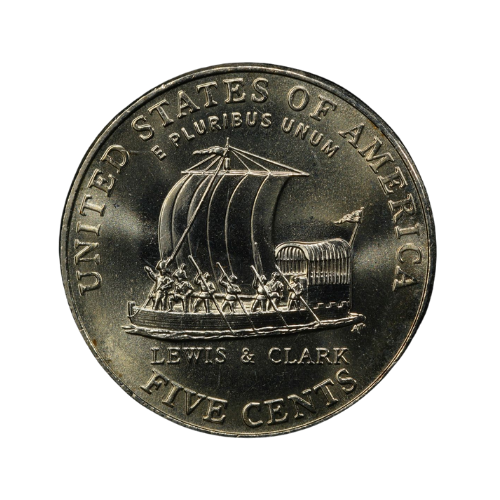
In 2004 and 2005, the U.S. Mint temporarily redesigned the Jefferson nickel to commemorate the bicentennial of the Lewis and Clark Expedition and the Louisiana Purchase. While the composition remained the standard 75% copper and 25% nickel, both the obverse and reverse designs were modified during this two-year series.
2004 Designs (Two Reverse Types):
Peace Medal Reverse – Depicts the Indian Peace Medal given to Native American leaders during the expedition.
Keelboat Reverse – Shows the expedition’s keelboat used to transport men and supplies.
Both 2004 coins retained the original left-facing portrait of Thomas Jefferson.
2005 Designs (Two Types):
American Bison Reverse – Features a detailed image of a buffalo, echoing classic frontier imagery.
Ocean in View Reverse – Displays the inscription “Ocean in View! O! The Joy!” taken from expedition journals.
In 2005, the obverse portrait of Jefferson was redesigned into a forward-facing image, marking the first major change to his likeness since 1938.
The Westward Journey series is widely collected by date and design type. Though common in circulation, these coins represent an important modern transition in the Jefferson nickel series and paved the way for the updated forward-facing portrait introduced in 2006.
2004-P Obverse
Peace Medal Reverse
Keelboat Reverse
2005-P Obverse
American Bison Reverse
Western Waters Reverse
-
2004-P Peace Medal | 361,440,000
2004-D Peace Medal | 372,000,000
2004-P Keelboat | 366,720,000
2004-D Keelboat | 344,880,000
2005-P American Bison | 448,320,000
2005-D American Bison | 487,680,000
2005-P Ocean in View | 394,080,000
2005-D Ocean in View | 411,120,000
-
2004-S Proof Peace Medal | 2,992,069
2004-S Proof Keelboat | 2,965,422
2005-S Proof American Bison | 3,344,679
2005-S Proof Ocean in View | 3,344,679
Jefferson Nickel, Return to Monticello
In 2006, the Jefferson nickel adopted a refreshed permanent design following the conclusion of the Westward Journey series. The obverse features a new forward-facing portrait of Thomas Jefferson, adapted from a portrait by Rembrandt Peale, giving the coin a more modern appearance while maintaining historical inspiration.
The reverse returned to a detailed depiction of Monticello, Jefferson’s Virginia home, rendered with greater architectural precision than earlier versions. The inscription “E PLURIBUS UNUM,” previously on the reverse, was moved to the obverse beginning in 2006.
The composition has remained the standard 75% copper and 25% nickel alloy. While most issues are common in circulation, collectors often search for high-grade examples, doubled dies, and other modern varieties. The Return to Monticello design continues today, extending one of the longest uninterrupted portrait series in U.S. coinage.
(2006 - Current)
-
2006-P | 693,120,000
2006-D | 809,280,000
2007-P | 571,680,000
2007-D | 626,160,000
2008-P | 279,840,000
2008-D | 345,600,000
2009-P | 39,840,000
2009-D | 46,800,000
2010-P | 260,640,000
2010-D | 229,920,000
2011-P | 450,000,000
2011-D | 540,240,000
2012-P | 464,640,000
2012-D | 558,960,000
2013-P | 607,440,000
2013-D | 615,600,000
2014-P | 635,520,000
2014-D | 570,720,000
2015-P | 752,880,000
2015-D | 846,720,000
2016-P | 786,960,000
2016-D | 759,600,000
2017-P | 710,160,000
2017-D | 663,120,000
2018-P | 629,520,000
2018-D | 626,880,000
2019-P | 567,854,400
2019-D | 527,040,000
2020-P | 772,780,000
2020-D | 798,000,000
2020-W | 465,080
2021-P | 785,500,000
2021-D | 837,600,000
2022-P | 769,920,000
2022-D | 777,600,000
2023-P | 692,600,000
2023-D | 734,800,000
2024-P | TBD
2024-D | TBD
2025-P | TBD
2025-D | TBD
-
2006-S Proof | 3,054,436
2007-S Proof | 2,577,166
2008-S Proof | 2,169,561
2009-S Proof | 2,179,867
2010-S Proof | 1,689,216
2011-S Proof | 1,673,010
2012-S Proof | 1,239,148
2013-S Proof | 1,274,505
2014-S Proof | 1,190,369
2015-S Proof | 1,099,182
2016-S Proof | 1,011,624
2017-S Proof | 979,477
2018-S Proof | 901,072
2019-S Proof | 1,061,558
2020-S Proof | 824,332
2020-W Reverse Proof | 313,184
2021-S Proof | 792,612
2022-S Proof | 647,021
2023-S Proof | 553,000
2024-S Proof | TBD
2025-S Proof | TBD
If You Collect Five-Cent Nickels, Check Out The ‘Silver Alloy War Nickels’ Type Set!
‘Coin Collecting Tools’ is Going Mobile
StackHub is an excellent tool for coin collectors & precious metals enthusiasts of all levels. Your app subscription will come complete with:
100+ prebuilt collection checklists to choose from
Collect graded or ungraded coins, your choice
Upload images of your own set to take on the go
Precious Metals stack tracking
Every coin collecting guide at your fingertips
Compatible with mobile & desktop
Click HERE to learn more*During checkout, please use the email address that you’d like associated with your StackHub account. You will receive an invitation to that email address directly from the platform when your account is ready. Account creation may take up to 12 hours from the time of checkout*
Understanding Proof Coins - The Essential Guide
Proof coins are some of the most beautiful coins ever made. Learn the difference between proof, cameo, and deep cameo coins — and why collectors value them.
Click here for the full guide
How to Avoid Buying Fake Coins Online
Not every coin listed online is the real deal. Discover the key steps to spotting counterfeits, protecting your collection, and buying with confidence.
Read More
This site and all of its content was built by collectors for collectors. Join thousands who already trust CoinCollectingTools.com for reliable & accurate information, expert tips, and a connected community on social media. Follow us on YouTube & TikTok @CentsMakeDollars to make sure you never miss a new online resource designed to sharpen your knowledge and collecting strategies.