U.S. Three-Cent Coins

(1851 - 1889)

U.S. Three-Cent Coins were created to support everyday transactions during a time of changing metal prices and postal rates. First struck in silver and later in copper-nickel, the three-cent piece was designed to facilitate the purchase of postage stamps and small goods. Despite its practicality, the coin proved unpopular due to its small size and confusing appearance. As economic conditions stabilized and other denominations filled its role, the three-cent coin was discontinued, making it one of the shortest-lived and most distinctive denominations in U.S. history.

Check out every series of U.S. Three-Cent Coins below, complete with dates & mintages for each.

Three-Cent Silver ‘Trime’

(1851 - 1873)

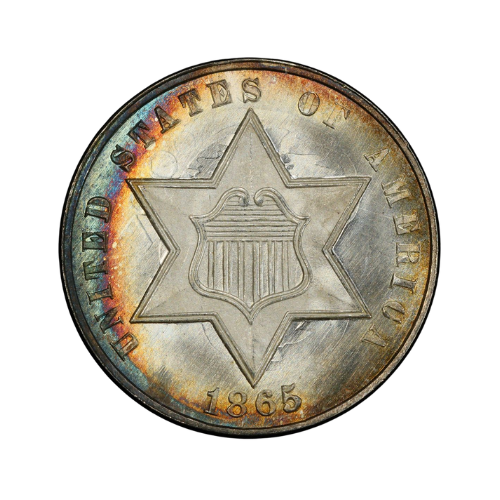
The Three-Cent Silver, often nicknamed the “Trime,” was struck from 1851 to 1873. It was introduced to help facilitate the purchase of postage stamps after postal rates were reduced to three cents. Its small size and low silver content made it convenient for everyday transactions at the time.

The series went through three distinct design types. The first (1851–1853) contained 75% silver and 25% copper. Beginning in 1854, the composition was adjusted to 90% silver and 10% copper, where it remained through the end of the series. Design modifications during this transition created the commonly referenced Type 1, Type 2, and Type 3 varieties.

Due to its tiny diameter — one of the smallest coins ever produced by the U.S. Mint — the Trime was easily lost and often heavily worn. Production declined after the Civil War as other small-denomination coins, including the Three-Cent Nickel, replaced its usefulness. The denomination was officially discontinued in 1873.

1865 3C Silver both sides of a toned silver coin showing a star with shield and roman numeral 3
  • Type 1, Small Star

    1851 | 5,447,400

    1851-O | 720,000

    1852 | 18,663,500

    1853 | 11,400,000

    Type 2, Large Star, Three Lines

    1854 | 671,000

    1855 | 139,000

    1856 | 1,458,000

    1857 | 1,042,000

    1858 | 1,603,700

    Type 3, Large Star, Two Lines

    1859 | 364,200

    1860 | 286,000

    1861 | 497,000

    1862 | 343,000

    1863 | 21,000

    1864 | 12,000

    1865 | 8,000

    1866 | 22,000

    1867 | 4,000

    1868 | 3,500

    1869 | 4,500

    1870 | 3,000

    1871 | 3,400

    1872 | 1,000

  • Type 2, Large Star, Three Lines

    1854 Proof | 30

    1855 Proof | 20

    1856 Proof | 100

    1857 Proof | 300

    1858 Proof | 210

    Type 2, Large Star, Two Lines

    1859 Proof | 800

    1860 Proof | 1,000

    1861 Proof | 1,000

    1862 Proof | 550

    1863 Proof | 460

    1864 Proof | 470

    1865 Proof | 500

    1866 Proof | 725

    1867 Proof | 625

    1868 Proof | 600

    1869 Proof | 600

    1870 Proof | 1,000

    1871 Proof | 960

    1872 Proof | 950

    1873 Proof | 600

Three-Cent Nickel

(1865 - 1889)

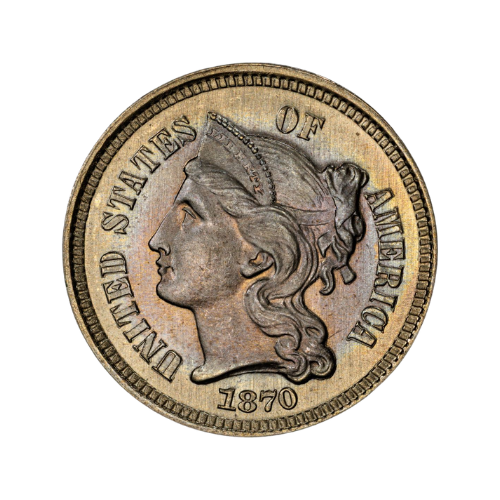
The Three-Cent Nickel was produced from 1865 through 1889 as a replacement for the earlier silver three-cent piece. Introduced during the Civil War era when silver coins were disappearing from circulation, the new nickel-based coin offered a more practical, lower-cost alternative. The obverse features a left-facing portrait of Liberty, while the reverse displays a large Roman numeral “III” encircled by a wreath.

These coins were composed of 75% copper and 25% nickel — the same alloy used for early Shield Nickels. Although intended for everyday commerce, demand declined as other small-denomination coins became more practical, and mintages dropped sharply in the 1880s. The final year, 1889, saw very limited production.

While often overlooked, the Three-Cent Nickel represents an important transitional denomination in post–Civil War American coinage.

1870 3C Nickel both sides of an old united states of America coin showing Liberty and the roman numeral 3
  • 1865 | 11,382,000

    1866 | 4,801,000

    1867 | 3,915,000

    1868 | 3,252,000

    1869 | 1,604,000

    1870 | 1,335,000

    1871 | 604,000

    1872 | 862,000

    1873 | 1,173,000

    1874 | 790,000

    1875 | 228,000

    1876 | 162,000

    1877 | 510

    1878 | 2,350

    1879 | 38,000

    1880 | 21,000

    1881 | 1,077,000

    1882 | 22,200

    1883 | 4,000

    1886 | 4,290

    1887 | 5,000

    1888 | 36,501

    1889 | 18,125

  • 1865 Proof | 500

    1866 Proof | 725

    1867 Proof | 625

    1868 Proof | 600

    1869 Proof | 600

    1870 Proof | 1,000

    1871 Proof | 960

    1872 Proof | 950

    1873 Proof | 1,150

    1874 Proof | 700

    1875 Proof | 700

    1876 Proof | 1,150

    1877 Proof | 510

    1878 Proof | 2,350

    1879 Proof | 3,200

    1880 Proof | 3,955

    1881 Proof | 3,575

    1882 Proof | 3,100

    1883 Proof | 3,983

    1884 Proof | 3,942

    1885 Proof | 3,790

    1886 Proof | 4,290

    1887 Proof | 4,290

    1888 Proof | 4,582

    1889 Proof | 3,336

If You Collect Three-Cent Coins, Check Out The ‘US Odd Denominations’ Type Set!

checklist for united states odd denomination coins from 1793 - 1889

‘Coin Collecting Tools’ is Going Mobile

StackHub App Monthly Membership StackHub App Monthly Membership
Quick View
StackHub App Monthly Membership
$4.99 every month

StackHub is an excellent tool for coin collectors & precious metals enthusiasts of all levels. Your app subscription will come complete with:

  • 100+ prebuilt collection checklists to choose from

  • Collect graded or ungraded coins, your choice

  • Upload images of your own set to take on the go

  • Precious Metals stack tracking

  • Every coin collecting guide at your fingertips

  • Compatible with mobile & desktop

Click HERE to learn more

*During checkout, please use the email address that you’d like associated with your StackHub account. You will receive an invitation to that email address directly from the platform when your account is ready. Account creation may take up to 12 hours from the time of checkout*

US constitutional silver coins, franklin half dollar, silver quarter, mercury dime

Check Out Our Guide to Identifying U.S. Constitutional Silver Coins

Think you might have silver coins in your pocket change? Learn the quick ways to spot United States Coinage made of silver by date, edge color, weight, and more.

Click HERE for the full guide
a coin roll from the bank with ten cent dimes, the face of a Roosevelt dime on the end

Coin Roll Hunting: What It Is and How to Start

Coin roll hunting is the modern-day treasure hunt for collectors. Learn what it is, how to start, and the best tips for finding silver and rare coins in rolls.

Read More

This site and all of its content was built by collectors for collectors. Join thousands who already trust CoinCollectingTools.com for reliable & accurate information, expert tips, and a connected community on social media. Follow us on YouTube & TikTok @CentsMakeDollars to make sure you never miss a new online resource designed to sharpen your knowledge and collecting strategies.