U.S. Pre-1933 Gold Coinage
(1795 - 1933)
U.S. gold coinage represents one of the most important and visually striking chapters in American monetary history. First authorized in 1792, gold coins were issued in a wide range of denominations and served as the backbone of high-value commerce throughout the 19th and early 20th centuries. These coins reflected the nation’s economic growth, westward expansion, and evolving artistic tastes, with designs ranging from early neoclassical portraits to some of the most celebrated works in all of U.S. coinage. The discovery of gold during the California Gold Rush dramatically increased gold coin production and led to the introduction of new denominations and branch mints across the country. Over time, U.S. gold coins transitioned from hand-prepared planchets and simple dies to highly refined minting techniques, producing issues that are both historically significant and aesthetically admired. Gold coinage came to an end in 1933 amid sweeping changes to U.S. monetary policy, marking the close of an era in circulating precious-metal currency. Today, U.S. gold coins are prized not only for their intrinsic metal content but also for their historical context, artistry, and role in shaping the American financial system. They remain a cornerstone of advanced numismatic collecting and a tangible link to the nation’s economic past.
Check out every series of U.S. Gold Coinage below, organized by their original face values.
$1 Gold Dollar
(1849 - 1889)
The $1 Gold Dollar was introduced in 1849 during the California Gold Rush, providing a convenient small-denomination gold coin for circulation. Over its 40-year run, the series was produced in three distinct design types. All were struck in 90% gold and 10% copper, with a standard weight of 1.672 grams.

Type 1 (1849–1854) – Liberty Head:
Designed by James B. Longacre, the obverse features a coroneted Liberty head, while the reverse displays a simple wreath encircling the denomination and date. At just 13 mm in diameter, this is the smallest coin ever issued for regular circulation by the United States. Its tiny size led to complaints about ease of loss.
-
1849
1849-C
1849-D
1849-O
1850
1850-C
1850-D
1850-O
1851
1851-C
1851-D
1851-O
1852
1852-C
1852-D
1852-O
1853
1853-C
1853-D
1853-O
1854
1854-D
1854-S
Type 2 (1854–1856) – Indian Princess (Small Head):
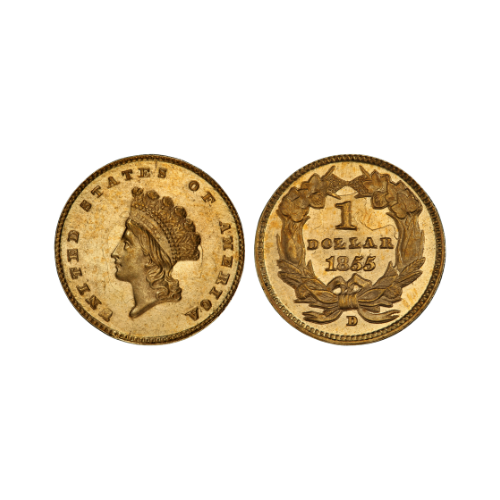
To address size concerns, the Mint increased the diameter to 15 mm and reduced thickness. The obverse depicts an Indian Princess wearing a feathered headdress (often mistaken for a Native American design, though modeled after Liberty). The smaller central portrait and large open fields resulted in weak strikes and poor durability, making this the shortest-lived and scarcest type overall.
-
1854
1855
1855-C
1855-D
1855-O
1856-S
Type 3 (1856–1889) – Indian Princess (Large Head):
The portrait was enlarged and repositioned to improve strike quality and metal flow. This final design proved more practical and remained in production for over three decades. Later issues were often struck in lower mintages, particularly from branch mints such as Charlotte and Dahlonega.
Though small in size, $1 Gold Dollars are highly collectible today due to their Gold Rush origins, multiple design types, and branch mint history. High-grade examples are especially desirable, as many saw circulation or were easily damaged due to their delicate dimensions.

-
1856
1856-D
1856-S
1857
1857-C
1857-D
1857-S
1858
1858-C
1858-D
1858-S
1859
1859-C
1859-D
1859-S
1860
1860-D
1860-S
1861
1861-C
1861-D
1861-S
1862
1862-D
1863
1863-D
1864
1865
1866
1867
1868
1869
1870
1870-S
1871
1871-CC
1871-S
1872
1872-CC
1873 Closed 3
1873 Open 3
1873-CC
1874
1874-CC
1875
1875-CC
1876
1876-CC
1877
1877-CC
1878
1878-CC
1879
1879-CC
1880
1880-CC
1881
1881-CC
1882
1882-CC
1883
1883-CC
1884
1884-CC
1885
1885-CC
1886
1886-CC
1887
1887-CC
1888
1888-CC
1889
1889-CC
$2.50 Gold Quarter Eagle
(1796 - 1929)
The $2.50 Gold Quarter Eagle was one of the longest-running denominations in U.S. gold coinage, produced intermittently from 1796 through 1929. All regular issues were struck in 90% gold and 10% copper. The weight standard was 4.37 grams until 1834, when it was reduced to 4.18 grams to align with changes in gold valuation.
The denomination features five major design types:

Draped Bust (1796–1807)
Engraved by Robert Scot, the obverse shows Liberty with draped bust and flowing hair. Early issues feature a Small Eagle reverse (1796 only), followed by the Heraldic Eagle beginning in 1796–1807. These are scarce early gold issues and foundational to U.S. numismatics.
-
1796 No Stars
1796 With Stars
1797
1798
1802
1804
1805
1806
1807

Capped Bust (1808–1834)
Designed by John Reich, this type features Liberty wearing a soft cap on the obverse and a Heraldic Eagle reverse. Only one year (1808) was struck under the original weight standard; later issues resumed in 1821. Production ceased in 1834 when the weight was reduced.
-
1808
1821
1824
1825
1826
1827
1829
1830
1831
1832
1833
1834

Classic Head (1834–1839)
Designed by William Kneass, this type reflects the post-1834 weight reduction to 4.18 grams. The lighter weight discouraged melting after changes in gold value. The reverse retained a modified eagle design. Southern branch mint issues (Charlotte and Dahlonega) are especially popular.
-
1834
1835
1836
1837
1838
1838-C
1839
1839-C
1839-D
1839-O

Liberty Head (1840–1907)
Designed by Christian Gobrecht, this long-running type features a coroneted Liberty head and a heraldic eagle reverse. In 1866, the motto “IN GOD WE TRUST” was added to the reverse. Produced across multiple mints, this type offers numerous collectible dates and branch mint varieties.
-
1840
1840-C
1840-D
1840-O
1841
1842
1842-C
1842-D
1842-O
1843
1843-C Large Date
1843-C Small Date
1843-D
1843-O
1844
1844-C
1844-D
1844-O
1845
1845-C
1845-D
1845-O
1846
1846-C
1846-D
1846-O
1847
1847-C
1847-D
1847-O
1848
1848-C
1848-D
1848-O
1849
1849-C
1849-D
1849-O
1850
1850-C
1850-D
1850-O
1851
1851-C
1851-D
1851-O
1852
1852-C
1852-D
1852-O
1853
1853-C
1853-D
1853-O
1854
1854-C
1854-D
1854-O
1855
1855-C
1855-D
1855-O
1856
1856-C
1856-D
1856-O
1857
1857-C
1857-D
1857-O
1858
1858-C
1858-D
1858-O
1859
1859-C
1859-D
1859-O
1860
1860-C
1860-D
1860-O
1861
1861-C
1861-D
1861-O
1862
1863
1864
1865
1866
1867
1868
1869
1870
1871
1872
1873 Closed 3
1873 Open 3
1874
1875
1876
1877
1878
1879
1880
1881
1882
1883
1884
1885
1886
1887
1888
1889
1890
1891
1892
1893
1894
1895
1896
1897
1898
1899
1900
1901
1902
1903
1904
1905
1906
1907

Indian Head (1908–1929)
Designed by Bela Lyon Pratt, this innovative design features incuse (sunken) devices rather than raised elements. The obverse depicts a Native American portrait, while the reverse shows a standing eagle. This unusual recessed design was controversial at the time but remains distinctive today. Production ended in 1929 as circulating gold coinage ceased during the Great Depression.
-
1908
1908-D
1909
1909-D
1910
1910-D
1911
1911-D
1912
1912-D
1913
1913-D
1914
1914-D
1915
1925-D
1926
1926-D
1927
1927-D
1928
1929
Gold Three-Dollar Coin
(1854- 1889)
The $3 Gold Coin was introduced in 1854, the same year as the Type 2 Gold Dollar and the $20 Double Eagle, during a period of expanding gold coinage following the California Gold Rush. Struck in 90% gold and 10% copper, the coin weighs 5.02 grams and measures 20.5 mm in diameter.
Designed by James B. Longacre, the obverse features a portrait of Liberty wearing a Native American headdress, a motif also seen on the Gold Dollar Type 2 and Type 3 designs. The reverse displays a wreath composed of corn, wheat, cotton, and tobacco—symbolizing American agricultural abundance—surrounding the denomination and date.
The denomination was intended in part to facilitate the purchase of sheets of 100 three-cent postage stamps, though it never achieved widespread commercial use. Mintages were generally low, particularly in later years, and many coins were saved in uncirculated condition.
Production ended in 1889, and the series contains no major design changes, making it a single-type coin. Despite its limited practical success, the $3 Gold Coin remains a distinctive and collectible denomination within 19th-century U.S. gold coinage.

-
1854
1854-D
1854-O
1855
1855-S
1856
1856-S
1857
1857-S
1858
1859
1860
1860-S
1861
1862
1863
1864
1865
1866
1867
1868
1869
1870
1871
1872
1873
1874
1877
1878
1879
1880
1881
1882
1883
1884
1885
1886
1887
1888
1889
$5 Gold Half Eagle
(1795 - 1929)
The $5 Gold Half Eagle was one of the most important workhorse denominations in early American commerce. Struck in 90% gold and 10% copper, the weight standard was 8.75 grams until 1834, when it was reduced to 8.36 grams following adjustments to the nation’s gold valuation. The series spans five major design types:

Draped Bust (1795–1807)
Designed by Robert Scot, the obverse features Liberty with flowing hair and draped bust. Early issues include the Small Eagle reverse (1795–1798), followed by the Heraldic Eagle beginning in 1795–1807. These represent some of the earliest federal gold coins struck by the United States.
-
1795
1796
1797
1798
1799
1800
1802
1803
1804
1805
1806
1807
Capped Bust (1807–1834)
Created by John Reich, this type shows Liberty wearing a soft cap, with a heraldic eagle reverse. Production halted after 1812 due to economic pressures and resumed in 1813, continuing until the 1834 weight reduction. Many examples saw heavy circulation.

-
1807
1808
1809
1810
1811
1812
1813
1814
1815
1818
1819
1820
1821
1822
1823
1824
1825
1826
1827
1828
1829
1830
1831
1832
1833
1834
Classic Head (1834–1838)
Designed by William Kneass, this short-lived type reflects the lighter 8.36-gram standard adopted in 1834. The design helped prevent melting under the old gold valuation system. Southern branch mint issues from Charlotte and Dahlonega add collector interest.

-
1834
1835
1836
1837
1838
1838-C
1838-D

Liberty Head (1839–1908)
Designed by Christian Gobrecht, this long-running type features a coroneted Liberty and heraldic eagle. In 1866, the motto “IN GOD WE TRUST” was added above the eagle. Produced across multiple mints—including Philadelphia, New Orleans, San Francisco, and the Southern branches—this is one of the most diverse gold series in U.S. coinage.
-
1839
1839-C
1839-D
1839-O
1840
1840-C
1840-D
1840-O
1841
1841-C
1841-D
1842
1842-C
1842-D
1843
1843-C
1843-D
1844
1844-C
1844-D
1844-O
1845
1845-C
1845-D
1846
1846-C
1846-D
1847
1847-C
1847-D
1848
1848-C
1848-D
1849
1849-C
1849-D
1850
1850-C
1850-D
1850-O
1851
1851-C
1851-D
1851-O
1852
1852-C
1852-D
1852-O
1853
1853-C
1853-D
1854
1854-C
1854-D
1854-O
1855
1855-C
1855-D
1856
1856-C
1856-D
1857
1857-C
1857-D
1858
1858-C
1858-D
1859
1859-D
1860
1860-D
1861
1861-D
1862
1862-D
1863
1863-D
1864
1864-D
1865
1865-D
1866
1866-C
1866-D
1867
1867-D
1868
1868-D
1869
1869-D
1870
1870-CC
1870-D
1871
1871-CC
1871-D
1872
1872-CC
1872-D
1873
1873-CC
1873-D
1874
1874-CC
1874-D
1874-S
1875
1875-C
1875-D
1875-S
1876
1876-CC
1876-D
1876-S
1877
1877-CC
1877-D
1877-S
1878
1878-CC
1878-D
1878-S
1879
1879-CC
1879-S
1880
1880-CC
1880-S
1881
1881-S
1882
1882-S
1883
1883-S
1884
1884-S
1885
1885-S
1886
1886-D
1886-S
1887
1887-S
1888
1888-S
1889
1889-S
1890
1890-S
1891
1891-S
1892
1892-S
1893
1893-S
1894
1894-S
1895
1895-S
1896
1896-S
1897
1897-S
1898
1898-S
1899
1899-S
1900
1900-S
1901
1901-S
1902
1902-S
1903
1903-S
1904
1904-S
1905
1905-S
1906
1906-S
1907
1907-S
1908
1908-S
Indian Head (1908–1929)
Designed by Bela Lyon Pratt, this innovative design features incuse (sunken) devices rather than raised elements. The obverse displays a Native American portrait, while the reverse shows a standing eagle. The unusual recessed design remains distinctive within American gold coinage. Production ended in 1929 as circulating gold coins were phased out in the early 20th century.

-
1908
1908-D
1908-S
1909
1909-D
1909-O
1909-S
1910
1910-D
1910-S
1911
1911-D
1911-S
1912
1912-S
1913
1913-S
1914
1914-D
1914-S
1915
1915-S
1916-S
1929
$10 Gold Eagle
(1795 - 1933)
The $10 Gold Eagle was a cornerstone denomination of early American gold coinage, widely used in domestic and international commerce. Struck in 90% gold and 10% copper, the weight standard was 17.50 grams until 1834, when it was reduced to 16.72 grams following changes in gold valuation. The series includes three major design types:
Draped Bust Eagle (1795–1804)
Designed by Robert Scot, the Draped Bust Eagle represents the first $10 gold coins struck by the United States. Early pieces (1795–1797) feature the Small Eagle reverse, which was quickly replaced by the Heraldic Eagle design beginning in 1797.
These early Eagles were produced in small numbers and primarily used for international trade and banking rather than everyday commerce. Many were later melted, making surviving examples scarce and highly desirable among collectors today.

-
1795
1796
1797
1798
1799
1800
1801
1803
1804
Liberty Head (1838–1907)
Designed by Christian Gobrecht, the Liberty Head Eagle features a coroneted Liberty on the obverse and a heraldic eagle on the reverse. In 1866, the motto “IN GOD WE TRUST” was added above the eagle. Produced at multiple mints—including Philadelphia, New Orleans, San Francisco, and Carson City—this long-running type saw heavy circulation and strong use in banking and trade.

-
1838
1839
1839-O
1840
1840-O
1841
1842
1842-O
1842-D
1843
1843-O
1843-D
1844
1844-O
1844-D
1845
1845-O
1845-D
1846
1846/5
1846-O
1846-D
1847
1847-O
1847-D
1848
1848-O
1848-D
1849
1849-O
1849-D
1850
1850-O
1850-D
1851
1851-O
1851-D
1852
1852-O
1852-D
1853
1853-O
1853-D
1854
1854-O
1854-S
1854-D
1855
1855-O
1855-S
1855-D
1856
1856-O
1856-S
1856-D
1857
1857-O
1857-S
1857-D
1858
1858-O
1858-S
1858-D
1859
1859-O
1859-S
1859-D
1860
1860-O
1860-S
1860-D
1861
1861-O
1861-S
1861-D
1862
1862-S
1863
1863-S
1864
1864-S
1865
1865-S
1866 No Motto
1866 With Motto
1866-S No Motto
1866-S With Motto
1867
1867-S
1868
1868-S
1869
1869-S
1870
1870-S
1870-CC
1871
1871-S
1871-CC
1872
1872-S
1872-CC
1873 Closed 3
1873 Open 3
1873-S
1873-CC
1874
1874-S
1874-CC
1875
1875-S
1875-CC
1876
1876-S
1876-CC
1877
1877-S
1877-CC
1878
1878-S
1878-CC
1879
1879-S
1879-CC
1880
1880-S
1880-CC
1881
1881-S
1881-CC
1882
1882-S
1882-CC
1883
1883-S
1883-CC
1884
1884-S
1884-CC
1885
1885-S
1885-CC
1886
1886-S
1887
1887-S
1888
1888-S
1889
1889-S
1890
1890-S
1891
1891-S
1892
1892-S
1893
1893-S
1894
1894-S
1895
1895-S
1896
1896-S
1897
1897-S
1898
1898-S
1899
1899-S
1900
1900-S
1901
1901-S
1902
1902-S
1903
1903-S
1904
1904-S
1905
1905-S
1906
1906-S
1906-D
1907
1907-S
1907-D
Indian Head (1907–1933)
Designed by Augustus Saint-Gaudens, this bold redesign features Liberty wearing a Native American war bonnet on the obverse and a perched eagle on the reverse. Unlike the Half Eagle Indian design, the devices are raised rather than incuse. The design reflects the broader artistic renaissance in U.S. coinage during the early 20th century.
Production of the $10 Eagle ended in 1933 when circulating gold coinage was discontinued in the United States. Today, the Gold Eagle series is prized for its blend of early federal rarity, branch mint history, and high-relief artistic achievement.

-
1907 No Motto
1907-D No Motto
1907-S No Motto
1908 No Motto
1908-D No Motto
1908-S No Motto
1908 With Motto
1908-D With Motto
1908-S With Motto
1909
1909-D
1909-S
1910
1910-D
1910-S
1911
1911-D
1911-S
1912
1912-D
1912-S
1913
1913-D
1913-S
1914
1914-D
1914-S
1915
1915-S
1916-S
1920-S
1926
1930-S
1932
1933
$20 Gold Double Eagle
(1849 - 1933)
The $20 Gold Double Eagle was the largest regular-issue gold coin struck for circulation in the United States. Authorized following the California Gold Rush, it became a major vehicle for large-scale banking, international trade, and gold storage. All issues were struck in 90% gold and 10% copper, with a standard weight of 33.44 grams.
The series consists of two primary design types:
Liberty Head (1850–1907)
Designed by James B. Longacre, the Liberty Head Double Eagle features a coroneted Liberty on the obverse and a heraldic eagle on the reverse. In 1866, the motto “IN GOD WE TRUST” was added above the eagle, creating two major subtypes (No Motto and With Motto).
This design was produced at multiple mints, including Philadelphia, New Orleans, San Francisco, and Carson City. Many Liberty Head Double Eagles were exported or melted, making certain dates scarce today.

-
1849
1850
1850-O
1851
1851-O
1851-S
1852
1852-O
1852-S
1853
1853-O
1853-S
1854
1854-O
1854-S Small Date
1854-S Large Date
1855
1855-O
1855-S
1856
1856-O
1856-S
1857
1857-O
1857-S
1858
1858-S
1859
1859-S
1860
1860-S
1861
1861-O
1861-S
1862
1862-S
1863
1863-S
1864
1864-S
1865
1865-S
1866 No Motto
1866 With Motto
1866-S No Motto
1866-S With Motto
1867
1867-S
1868
1868-S
1869
1869-S
1870
1870-CC
1870-S
1871
1871-CC
1871-S
1872
1872-CC
1872-S
1873 Closed 3
1873 Open 3
1873-CC
1873-S
1874
1874-CC
1874-S
1875
1875-CC
1875-S
1876
1876-CC
1876-S
1877
1877-CC
1877-S
1878
1878-CC
1878-S
1879
1879-CC
1879-S
1880
1880-CC
1880-S
1881
1881-CC
1881-S
1882
1882-CC
1882-S
1883
1883-CC
1883-S
1884
1884-CC
1884-S
1885
1885-CC
1885-S
1886
1886-S
1887
1887-S
1888
1888-S
1889
1889-CC
1889-S
1890
1890-CC
1890-S
1891
1891-CC
1891-S
1892
1892-CC
1892-S
1893
1893-CC
1893-S
1894
1894-S
1895
1895-S
1896
1896-S
1897
1897-S
1898
1898-S
1899
1899-S
1900
1900-S
1901
1901-S
1902
1902-S
1903
1903-S
1904
1904-S
1905
1905-S
1906
1906-D
1906-S
1907
1907-D
1907-S
1907
Saint-Gaudens (1907–1933)
Designed by Augustus Saint-Gaudens, this iconic redesign is widely considered one of the most beautiful coins ever produced by the United States. The obverse depicts Liberty striding forward holding a torch and olive branch, with the U.S. Capitol in the background. The reverse shows a soaring eagle in flight.
Early 1907 issues were struck in ultra high relief and high relief formats before being modified for practical circulation. The motto “IN GOD WE TRUST” was added in 1908 after initial public controversy over its omission.
Production of the Double Eagle ended in 1933 when gold coin circulation ceased in the United States. Many 1933-dated coins were melted before release, making surviving examples among the most famous rarities in American numismatics.

-
1907 High Relief Wire Rim
1907 High Relief Flat Rim
1907 No Motto
1907-D No Motto
1907-S No Motto
1908 No Motto
1908-D No Motto
1908-S No Motto
1908 With Motto
1908-D With Motto
1908-S With Motto
1909
1909-D
1909-S
1910
1910-D
1910-S
1911
1911-D
1911-S
1912
1912-D
1912-S
1913
1913-D
1913-S
1914
1914-D
1914-S
1915
1915-S
1916-S
1920
1920-S
1921
1922
1922-S
1923
1923-D
1923-S
1924
1924-D
1924-S
1925
1925-D
1925-S
1926
1926-D
1926-S
1927
1927-D
1927-S
1928
1928-D
1928-S
1929
1929-D
1930-S
1931
1931-D
1931-S
1932
1932-D
1932-S
1933
If You Collect U.S. Gold Coinage, Check Out The Gold Buffalo Bullion Coin Checklist!


Understanding Proof Coins - The Essential Guide
Proof coins are some of the most beautiful coins ever made. Learn the difference between proof, cameo, and deep cameo coins — and why collectors value them.
Click here for the full guide
Learn How ‘Karats’ Measure the Purity of Gold!
If you collect U.S. Gold Coinage, it is essential to learn the translations between karats and percentages.
Click here for the free PDF documentThis site and all of its content was built by collectors for collectors. Join thousands who already trust CoinCollectingTools.com for reliable & accurate information, expert tips, and a connected community on social media. Follow us on YouTube & TikTok @CentsMakeDollars to make sure you never miss a new online resource designed to sharpen your knowledge and collecting strategies.