U.S. Half-Dime Coins
(1794 - 1873)
U.S. Half Dimes were the first silver coins struck by the United States Mint and served as an essential small-denomination coin in early American commerce. Issued in several classic designs featuring Liberty and, later, an eagle or wreath reverse, the half dime circulated widely for nearly 80 years. As industrial metal production improved, the thicker copper-nickel five-cent coin eventually replaced it, leading to the half dime’s discontinuation in 1873. Today, half dimes represent an important bridge between early federal silver coinage and the modern nickel.
Check out every series of U.S. Half-Dime Coins below, complete with dates & mintages for each.
Bust ‘Half Disme’
(1792)
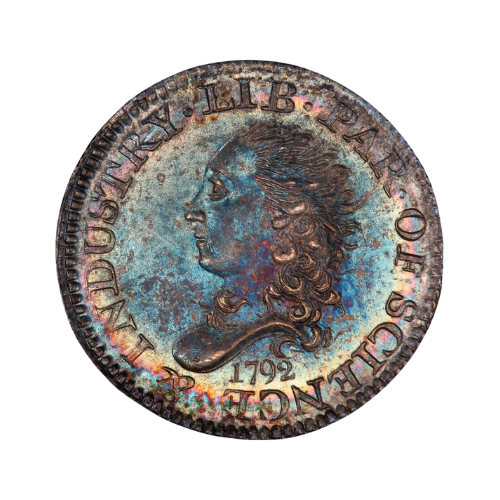
The 1792 Half Disme is widely recognized as one of the first silver coins struck under the authority of the United States. Produced shortly after passage of the Coinage Act of 1792, these pieces were likely struck in a temporary Philadelphia facility before the official Mint building was completed.
The obverse features Liberty with flowing hair, while the reverse displays a small eagle surrounded by a wreath. The coin was struck in an early silver standard of approximately 89.24% silver and 10.76% copper, consistent with the specifications later formalized for U.S. silver coinage.
With a small mintage of only 1,500 and immense historical importance, the 1792 Half Disme is considered a foundational issue in American numismatics and remains highly sought after in all grades today.
Flowing Hair Half-Dime
(1794 - 1795)
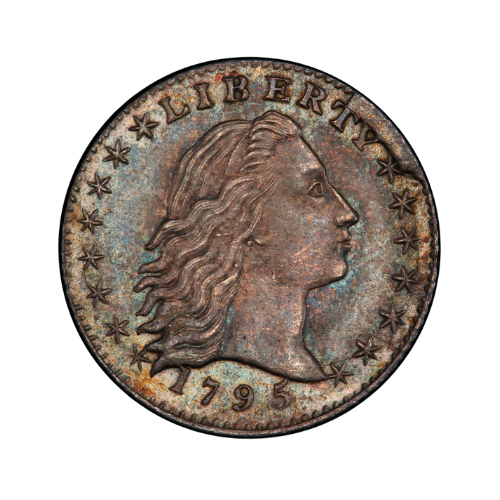
The Flowing Hair Half Dime was the first regularly issued five-cent silver coin struck for circulation by the United States Mint, produced from 1794 through 1795. It followed the experimental 1792 Half Disme and marked the true beginning of the denomination’s ongoing production.
The obverse features Liberty with long, flowing hair, while the reverse displays a small eagle encircled by a wreath. These coins were struck in the early federal silver standard of approximately 89.24% silver and 10.76% copper.
Mintages were modest, and many surviving examples show extensive circulation. As one of the earliest circulating silver types in U.S. history, the Flowing Hair Half Dime remains an important and highly collectible early federal issue.
-
1794 | 7,756
1795 | 78,660
Draped Bust Half-Dime
(1796 - 1805)
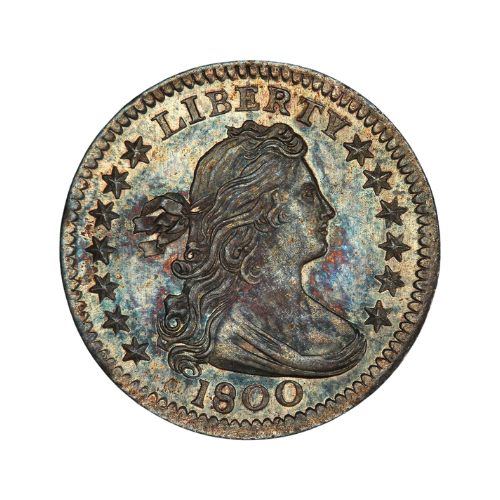
The Draped Bust Half Dime succeeded the Flowing Hair design and was struck from 1796 through 1805. The obverse features a more refined portrait of Liberty with drapery at the neckline, while the reverse initially displayed a small eagle (1796–1797) before transitioning to the Heraldic Eagle design beginning in 1800.
These coins were composed of approximately 89.24% silver and 10.76% copper, consistent with early U.S. silver standards. Production was intermittent, and mintages were generally low, particularly in the early years of the series.
Because of their age, limited survival rates, and multiple reverse types, Draped Bust Half Dimes are considered important early federal issues and are highly sought after in both circulated and higher-grade examples.
-
Type 1, Small Eagle
1796 | 10,230
1797 | 44,527
Type 2, Heraldic Eagle
1800 | 40,000
1801 | 27,760
1802 | 3,060
1803 | 37,850
1805 | 15,600
Capped Bust Half-Dime
(1829 - 1837)
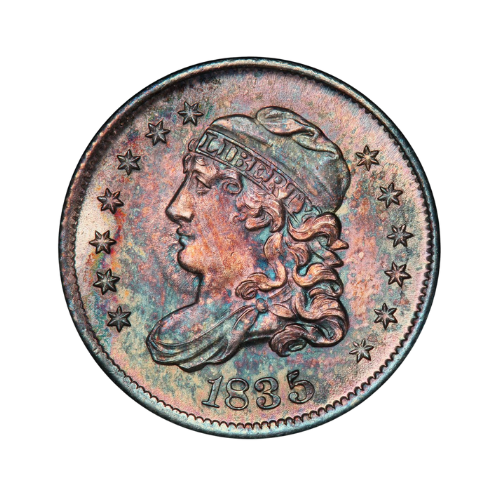
The Capped Bust Half Dime was introduced in 1829 following a long suspension of half dime production. Designed by John Reich and later refined by William Kneass, the obverse features Liberty wearing a soft cap, while the reverse displays a heraldic eagle with shield.
These coins were struck in a 89.24% silver and 10.76% copper composition through 1836. In 1837, the silver standard was adjusted to 90% silver and 10% copper, creating a one-year composition subtype within the series. The 1836–1837 issues also transitioned from the older lettered edge to a reeded edge as part of broader Mint improvements.
Produced only through 1837, the Capped Bust Half Dime represents a short but technically important period in U.S. coinage, bridging early hand-crafted designs with more modern minting standards.
-
1829 | 1,230,000
1830 | 1,240,000
1831 | 1,242,700
1832 | 965,000
1833 | 1,370,000
1834 | 1,480,000
1835 | 2,760,000
1836 | 1,900,000
1837 | 871,000
-
1829 Proof | 10
1830 Proof | 10
1831 Proof | 20
1832 Proof | 10
1833 Proof | 8
1834 Proof | 12
1835 Proof | 10
1836 Proof | 10
1837 Proof | 30
Seated Liberty Half-Dime
(1837 - 1873)
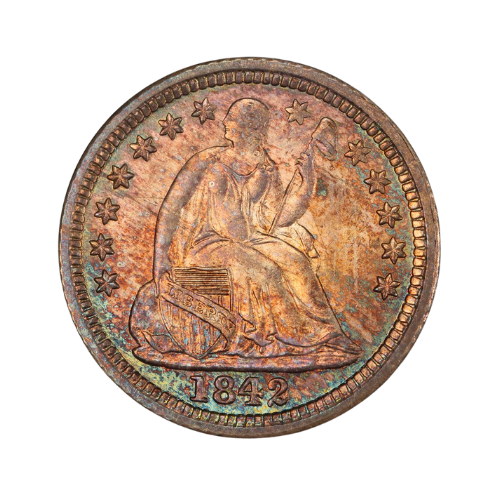
The Seated Liberty Half Dime replaced the Capped Bust design in 1837 and was struck through 1873. Designed by Christian Gobrecht, the obverse features Liberty seated on a rock holding a shield and pole, symbolizing vigilance and national strength, while the reverse displays a simple wreath surrounding the denomination.
Beginning in 1837, the composition was standardized at 90% silver and 10% copper, a silver alloy that remained consistent throughout the series. Over its long production span, several design modifications created collectible subtypes, including the addition of stars to the obverse in 1838 and the introduction of arrows at the date in 1853–1855 and again in 1873 to indicate minor weight adjustments.
As silver coins gradually disappeared from circulation after the Civil War, mintages declined. The denomination was officially discontinued in 1873, replaced by the five-cent nickel. The Seated Liberty Half Dime remains a classic 19th-century silver series with numerous dates and varieties appealing to type and advanced collectors alike.
-
Type 1, No Stars
1837 | 1,405,000
1838 | 3,546,000
1838-O | 70,000
Type 2, No Drapery
1839 | 1,069,000
1839-O | 150,000
1840 No Drapery | 1,034,000
1840-O No Drapery | 240,000
Type 3, Stars on Obverse
1840 Drapery | 310,085
1840-O No Drapery | 240,000
1841 | 1,227,000
1841-O | 845,000
1842 | 815,000
1842-O | 350,000
1843 | 815,000
1843-O | 720,000
1844 | 1,150,000
1844-O | 220,000
1845 | 590,000
1845-O | 240,000
1846 | 27,000
1847 | 120,000
1848 | 224,000
1849 | 180,000
1850 | 553,000
1851 | 100,000
1851-O | 290,000
1852 | 77,130
1853 No Arrows | 135,000
1853-O No Arrows | 1,050,000
Type 4, Arrows at Date
1853 Arrows | 13,210,020
1853-O Arrows | 2,200,000
1854 | 759,000
1854-O | 500,000
1855 | 7,000
1855-O | 600,000
Type 3, Stars on Obverse
1856 | 1,450,000
1856-O | 2,200,000
1857 | 3,540,000
1857-O | 600,000
1858 | 3,475,000
1858-O | 600,000
1859 | 8,720,000
1859-O | 560,000
Type 5, Legend Obverse
1860 | 949,000
1861 | 1,059,000
1862 | 1,467,000
1863 | 18,000
1864 | 13,000
1865 | 13,000
1866 | 8,000
1867 | 8,000
1868 | 88,600
1869 | 29,500
1870 | 535,000
1870-S | 300,000
1871 | 1,611,000
1871-S | 200,000
1872 | 1,385,000
1873 | 100,000
1860-O | 1,060,000
1863-S | 100,000
1864-S | 90,000
1865-S | 120,000
1866-S | 120,000
1867-S | 120,000
1868-S | 280,000
1869-S | 230,000
1872-S | 837,000
1873-S | 324,000
-
Type 5, Legend Obverse
1860 Proof | 1,000
1861 Proof | 1,000
1862 Proof | 550
1863 Proof | 460
1864 Proof | 470
1865 Proof | 500
1866 Proof | 725
1867 Proof | 625
1868 Proof | 600
1869 Proof | 600
1870 Proof | 1,000
1871 Proof | 960
1872 Proof | 950
1873 Proof | 600
‘Coin Collecting Tools’ is Going Mobile
StackHub is an excellent tool for coin collectors & precious metals enthusiasts of all levels. Your app subscription will come complete with:
100+ prebuilt collection checklists to choose from
Collect graded or ungraded coins, your choice
Upload images of your own set to take on the go
Precious Metals stack tracking
Every coin collecting guide at your fingertips
Compatible with mobile & desktop
Click HERE to learn more*During checkout, please use the email address that you’d like associated with your StackHub account. You will receive an invitation to that email address directly from the platform when your account is ready. Account creation may take up to 12 hours from the time of checkout*
How to Find Valuable Banknotes - A Beginner’s Guide to Bank-Strap Hunting
Click here for the full guideHow to Store Collectable Coins, Properly
Improper storage can ruin a coin’s value. Learn the best ways to protect your collection from scratches, spots, and unwanted toning with safe holders and tips.
Read MoreThis site and all of its content was built by collectors for collectors. Join thousands who already trust CoinCollectingTools.com for reliable & accurate information, expert tips, and a connected community on social media. Follow us on YouTube & TikTok @CentsMakeDollars to make sure you never miss a new online resource designed to sharpen your knowledge and collecting strategies.